Court of the Lord Lyon
Interlocutor of the
Lord Lyon King of Arms
in the Petition of
JAMES EDWARD MOIR MacARTHUR OF THAT ILK
(formerly James Edward Moir MacArthur of Milton)
of date 12 February 2001
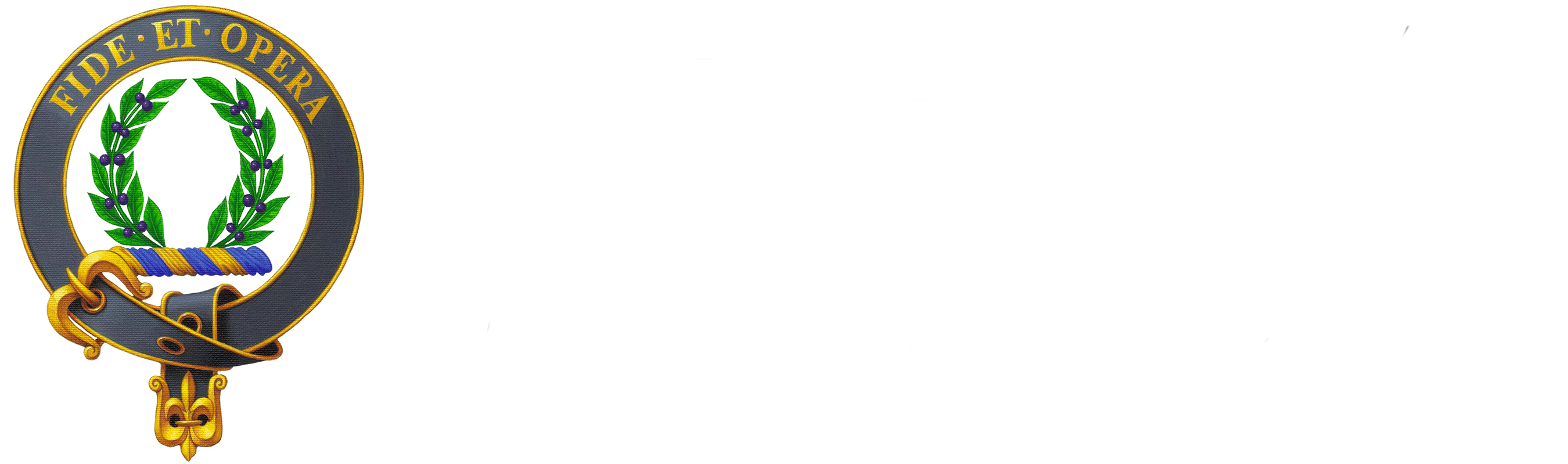
Edinburgh, 28 August 2002; The Lord Lyon King of Arms, having considered the foregoing Petition, with the Productions and Proof adduced, (Primo) for aught yet seen OFFICIALLY RECOGNISES the petitioner as James Edward Moir MacArthur of that Ilk, Chief of the Name and Arms of the Honourable Clan Arthur; (Secundo) for aught yet seen MAINTAINS, RATIFIES and CONFIRMS unto the Petitioner and his heirs, Chiefs of the Honourable Clan Arthur, the following Ensigns Armorial, Videlicet:-Azure, three antique crowns Or. Above the Shield is placed an Helm befitting his degree with a Mantling Azure doubled Or, and on a Wreath of the Liveries is set for Crest two branches of bay in orle Proper, and in an Escrol over the same this Motto "FIDE ET OPERA". And for his Standard three and a half metres long having Azure a St. Andrew's Cross Argent in the hoist, of two tracts Azure and Or with his Crest in the first and third compartments and a sprig of Wild Thyme Proper in the second compartment with this Slogan "EISD O EISD" in letters Or on two traverse bands Gules; and for Pinsel 135 centimetres long and 60 centimetres high Argent, bearing upon a Wreath of his Liveries Azure and Or, two branches of bay in orle Proper within a strap of leather Proper buckled and embellished Or inscribed with the Motto "FIDE ET OPERA" in letters of the Field all within a circlet Or, fimbriated Azure, bearing his title "MACARTHUR OF THAT ILK" in letters Sable, and in the fly on an Escrol Sable surmounting a aprig of Wild Thyme Proper, being the proper plant badge of the Clan Arthur, the Slogan "EISD O EISD" in letters of the Field; (Tertio) GRANTS WARRANT to the Lyon Clerk to prepare an Instrument of Confirmation and to matriculate the foresaid Ensigns Amorial in the Public Register of All Arms and Bearings in Scotland; and (Quarto) CONFIRMS the Petitioner as Representer of the Noble and Ancient House of MacArthur of Milton in the Ensigns Armorial matriculated in the Public Register of All Arms and Bearings in Scotland of date 25 August 1991 (Volume 70, Folio 110).
Note by Lord Lyon King of Arms in Petition of James Edward Moir MacArthur of Milton
There are two issues to be determined in this case. The first is the question of whether the Arthurs or MacArthurs are to be treated as a clan in their own right. The second is whether it has been established that the Petitioner is the rightful heir to be confirmed as Chief.
The Petition draws on many years of genealogical research undertaken by a number of different people. A considerable amount of research was done by Niall 10th Duke of Argyll in the 1930s. Then more recently research was done by Mrs. English and by Ian MacArthur. Arthur MacArthur of Philadelphia contributed a considerable amount of research and then in 1986 Hugh Peskett was commissioned to complete the search for a Chief. This Petition is based on Mr. Peskett's work in which he acknowledges particularly the value of the research done by Duke Niall of Argyll.
The Petition is based on following the descent of the MacArthurs of Tirivadich and Innistrynich. Clan Arthur is accepted as one of the oldest Clans of Argyll both by Sir Iain Moncreiffe of that Ilk in "The Highland Clans" and by Frank Adam and Sir Thomas Innes of Learney in "The Clans, Septs and Regiments of the Scottish Highlands". The research done by Mr. Peskett shows that the MacArthurs of Tirivadich are well documented from 1494 and that there is reason to believe that they were in a position of some importance from well before that date. It is also clear they were using armorial seals from the 16th century if not earlier. The evidence which has been presented confirms the views expressed in "The Highland Clans" and in "The Clans, Septs and Regiments of the Scottish Highlands" and I accept that the MacArthurs should be treated as a clan under the name Clan Arthur.
The research done by Duke Niall, which Mr. Peskett has verified using original sources rather than the Duke's transcripts wherever possible, traces the MacArthurs of Tirivadich from John MacArthur of Tirivadich who was alive in 1495 down nine generations through John MacArthur's eldest grandson Duncan MacArthur of Tirivadich and down three generations through John MacArthur's younger grandchildren Niall MacArthur of Querlane and John MacArthur of Drissaig. Mr. Peskett's research has identified two further generations in the main line, at which point this line becomes extinct. Duke Niall identified four sons of Niall MacArthur of Querlane and Mr. Peskett's research has found no further record of any descendants of any of these four sons. I am asked to accept the assumption that no such descendants exist. If there were any such descendants they would have a better claim than the Petitioner whose descent is from John MacArthur of Drissaig.
Before considering the Petitioner's own descent I must eliminate the possibility of there being any descendants who have not been found from Duncan MacArthur of Tirivadich or Niall MacArthur of Querlane. To do this I am asked to apply the principle non apparentibos ipsos non existentibus praesumuntur. This was applied inter alia MacNab of MacNab (1957 SLT Lyon Court 2) and in the Judgement given by Lord Normand on behalf of the Committee of Privileges of the House of Lords in Viscountcy of Dudhope (1986 SLT (HL) 6). There His Lordship states "There must come a time when, despite all uncertainties, the search for documents rigorously conducted will probably discover all the available evidence. I do not say that the research in this case has certainly discovered all the existing evidence, but I think it would be surprising if any new evidence were to be found." From the evidence which has been submitted I am satisfied that there is no obvious further research which has not been explored.
This Petition was ordered to be advertised in the Press and in the Clan Arthur Newsletter and while I have received correspondence indicating the possibility of other claims being made, no intimation of any competing claim has come forward within the time allowed. I therefore consider that it is proper for me to apply the non apparentibos principle in this case.
I turn now to the Petitioner's descent. The Petitioner was granted arms in 1991 and proved his genealogy at that time back to Margaret MacArthur Moir who died about 1775. In 1775 Archibald MacArthur Stewart recorded Arms. He was a great nephew of Margaret MacArthur Moir and his genealogy is recorded back to John MacArthur of Milton who died about 1674. Mr. Peskett's research provides the links to trace the genealogy of John MacArthur of Milton back to John MacArthur of Drissaig. The Petitioner's descent has thus been taken back to John MacArthur of Drissaig.
Accordingly I am prepared to accept that, since no other person with a better claim has come forward, the Petitioner is for aught yet seen the present Representer of the MacArthurs of Tirivadich and should therefore be accepted as Chief of Clan Arthur.
I will accordingly grant this Petition.